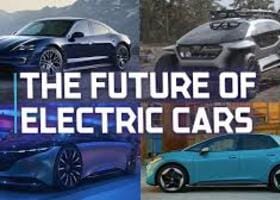
Electric cars are poised to become a major force in the automotive industry as concerns over climate change and the desire for sustainable transportation grow. The future of electric cars is bright, with technological advancements leading to increased range, faster charging times, and more affordable prices.
The adoption of electric cars has opened doors for future brands. There are new possibilities and ways to enhance both the vehicles and therefore the systems related to it, the facility system, for instance. Electric vehicles are being considered because of the way forward for vehicles, whereas the smart grid appears to be the grid of the longer term.
Future Of Electric Cars
V2G is that the link between these two technologies and both are benefiting from it. With V2G comes other essential systems required for a sustainable electric vehicle scenario: charge scheduling, VPP, smart metering, etc. Future charging technologies need to improve a lot to form electric cars widely accepted.
charging time
The charging time has got to be decreased extensively for creating electric cars more flexible. Better new electric car batteries are a must to take electric car technology further. There’s a requirement for batteries that use non-toxic materials and have higher power density, less cost and weight, more capacity, and need less time to recharge.
technologies
Though technologies better than Li-ion are discovered already, they’re not being pursued industrially due to the large costs related to creating a working version. Besides, Li-ion technology has the potential to be improved a lot more. Li-air batteries might be an honest choice to increase the range of electric cars.
Electric vehicles are likely to move faraway from using static magnet motors that use rare-earth materials. Motors with internal static magnet may stay in use.
Wireless power transfer systems are likely to exchange the present cabled charging system. Concepts revealed by major automakers adopted this feature to spotlight their usefulness and convenience.
Here is the construction of a car in Catia software. Within this site there is an article that presents the construction and operation of electric batteries for electric vehicles types and operations. types of ev
Vehicles that follow a delegated route along the highway, like trucks, can get their power from
overhead lines like trains or trams. It’ll allow them to collect energy as long as their route resides
with the facility lines, then carry on with energy from on-board sources.
new solutions
One of the new solutions for electric vehicles is solid-state batteries, which offer higher energy density, faster charging times, and increased safety. Another development is wireless charging, which allows electric vehicles to be charged simply by parking over a charging pad.
New ways of recovering energy from the vehicle may appear. Goodyear has demonstrated a tire which will harvest energy from the warmth generated there using thermo-piezoelectric material. There also are chances of solar-powered vehicles. Until now, these haven’t appeared useful as installed solar cells only manage to convert up to 20% of the input power.
Much research goes on to form the electronics and sensors in electric cars more compact, rugged, and cheaper—which in many cases are resulting in advanced solid-state devices that will achieve these goals with promises of cheaper products if they can be mass-produced.
Some examples are often the works on:
-gas sensors
-smart LED drivers
-smart drivers for automotive alternators
-advanced gearboxes
-compact and
-smart power switches to weather harsh conditions
Future research topics will, of course, revolve around making electric cars technology more efficient, affordable, and convenient. More of such researches is probably going to travel on emphasizing on better battery technologies, ultracapacitors, fuel cells, flywheels, turbines, and other individual and hybrid configurations.
battery technology
Better charging technologies will remain an important research topic in near future. This is often one of the areas the electric car technology is lacking very badly. Wireless charging technologies are very likely to draw in more researchers’ attention.
Plenty of research has already been done incorporating electric cars. Are new challenges and possibilities that electric cars bring with them to the existing grid and also to the grid of the future.
With more implementation of smart grids, distributed generation, and renewable energy sources, researches in these fields are likely to increase.
Furthermore, there are new electric car models being introduced by major car manufacturers that are designed to be more affordable and accessible to a wider range of consumers. Governments around the world are also providing incentives and investing in infrastructure to support the growth of electric vehicles.
Overall, the future of electric cars looks promising as more people recognize the benefits of sustainable transportation and the automotive industry continues to innovate and improve electric vehicle technology.
Vehicles that are equipped with electric power systems, sometimes referred to as electric vehicles or vehicles with electric drive, can be generally characterized as those containing a traction battery along with one or more electric motors. These components provide either complete or partial power necessary for the vehicle’s movement. Electric power systems encompass various types of vehicles, including hybrid electric vehicles (HEVs) that do not require plugging in, plug-in hybrid electric vehicles (PHEVs), battery electric vehicles (BEVs), hydrogen fuel cell electric vehicles (FCEVs), and plug-in fuel cell electric vehicles (PFCEVs).
All forms of electric power systems aim to lower the emissions of greenhouse gases (GHGs) in comparison to traditional vehicles that use internal combustion engines (ICEs). For HEVs, which derive energy from fuel combustion similar to ICEs, reductions in GHG emissions are achieved through enhanced fuel efficiency. This improvement is attributed to common features in all electric power systems, which include: (i) regenerative braking that enables the recovery of kinetic energy during braking by allowing the electric motor(s) to function as generators, (ii) the capacity to store energy in the traction battery, and (iii) the high-efficiency output of electric motors over a wide range of torque and speed, facilitating optimal engine performance by using the motor(s) for acceleration assistance. This allows the engine to function efficiently within its designated torque-speed zone or completely shut down when power needs are minimal.
For specific larger vehicles, like full-size pickup trucks (FSPTs), the savings in fuel consumption—corresponding to a decrease in tailpipe GHG emissions—are estimated to be around 10% when assessing the fuel economy metrics of existing FSPT models that are available in both ICE and HEV setups.
The transition of energy sources in road transportation is becoming a critical priority for climate policies in Europe. The decarbonization of the continent’s road transport sector increasingly relies not only on the growth of plug-in vehicle adoption but also on the prompt development and efficient operation of public charging facilities.
From a public policy and transition management viewpoint, it is essential to analyze how the expansion of the electric vehicle population correlates with the advancement of infrastructure. If the development of infrastructure occurs faster than the rise in user base, it can lead to congestion. This congestion may manifest as waiting lines, insufficient charging stations, and lengthened wait times. Such situations may negatively affect public acceptance and impede further growth in electric vehicle adoption.
The average carbon dioxide emissions from newly registered vehicles are maintained purely as a contextual environmental measure, rather than serving as a variable for rigorous inferential analysis within the brief evaluation timeframe.