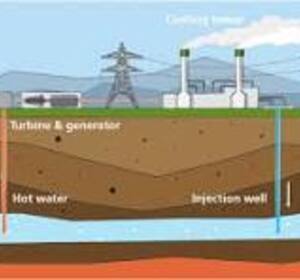
Geothermal energy is one of many possible alternatives to the modern fossil fuel industry. Geothermal energy uses the heat of radioactive particles below the Earth’s surface, which is produced in the form of hot water and steam.
Most underground temperatures are used directly for heating and cooling systems. The advantage of geothermal systems is that they provide direct heating and cooling, thus reducing the burden on other renewable sources, wherever they are found in the world, but are widely exploited. As a result, most geothermal power plants are concentrated in small areas, in the corners of the world.
The Earth’s internal heat does the work to create the vapor we inhale. The planet gets its internal heat from pressure and density, as well as from the Sun. When the power is on, the pumps pump water back into the ground through a system of injection wells. Returning the product is safe and completes the cycle that makes geothermal energy a renewable energy source. There are three main methods of converting geothermal resources into electricity: dry steam, flush steam, and the binary cycle.
Binary Cucle Plants
Development of advanced setups. Loop plants use oil to heat and produce secondary water (usually isobutane).
This secondary water boils with air, which drives a turbine that produces electricity through an electric generator. This water is then cooled and recycled for reuse.
Heat from geothermal energy is lost, but the water returns to the ground where it can be reheated. This makes it safe and environmentally friendly without polluting the water cycle.
Flash Steam Plants
These power plants also use hot water directly.
Geothermal hot water is pressurized in a reservoir. This tank is known as the ‘flash tank’. Since the tank is colder than the outside temperature, the water inside evaporates.
This turbine then drives the turbine. The water vapor is condensed back into fresh water and then injected into the ground.
The purpose of this system is to produce instantaneous energy by multiplying the energy. This also allows the factory to control the production of long-lasting machines.
Dry plants
The first and most common geothermal power plant is the dry model.These plants directly pipe steam from a reservoir into a turbine. The turbine spins and the steam condenses as it cools. The resulting water is then recaptured and injected back into the ground.
This model is cheap to make and straightforward in its engineering. The downside, of course, is that they are less efficient than others mentioned here.
Buildings represent 40% of worldwide energy use and contribute to one-third of all greenhouse gas emissions. Renewable energy solutions, such as solar PV systems and geothermal heating units, play a vital role in reducing carbon emissions.
Major Components of a Geothermal Energy Facility
• Production Wells: Boreholes created 1 to 2 miles into the ground to extract superheated water or steam from deeper layers.
• Steam / Flash Tank: A container operating at low pressure that causes high-pressure hot water to rapidly turn into steam (in flash plants).
• Heat Exchanger: Employed in binary-cycle facilities to facilitate the transfer of heat from subterranean water to an alternate working fluid that has a lower boiling temperature.
• Turbine: A sizable mechanical apparatus that is driven by expanding steam or vaporized secondary fluid.
• Generator: Linked to the turbine to transform the rotational kinetic energy into electrical energy.
• Condenser: Serves to cool and revert the expelled steam back into liquid form.
The property of thermal conductivity is essential in geological and shallow geothermal construction, as it affects the design, effectiveness, and durability of ground heat exchangers, energy piles, and ground-source heat pumps. Achieving dependable measurements of this property in sandy soils is difficult due to complex relationships involving water content, overall density, and the arrangement of soil particles.
Energy pile technology combines the utilization of geothermal energy with the load-bearing capacity of pile foundations. However, it is still theoretically difficult to accurately assess its thermal and mechanical capabilities.
The primary mechanisms of heat transfer are examined, highlighting how conductivity, viscosity, and heat capacity interact with fluid movement to impact energy transfer efficiency, hydraulic resistance, and dependability of the system. Particular focus is placed on nanofluids, whose improved thermal characteristics depend on the type of nanoparticles used, their concentration, stability of dispersion, and flow conditions. The literature review evaluates stabilization methods like surfactants, functionalization, and pH regulation for sustaining long-term system performance.
Although shallow geothermal systems are adaptable and efficient, detailed Life Cycle Assessments (LCA) are limited in existing research. A comparative LCA against standard double U-tube systems indicates comparable overall environmental effects. A sensitivity analysis of the coaxial probes was performed to investigate possible strategies for diminishing the related environmental impacts, offering insights for eco-friendly design. The LCA results indicate that refining the design, particularly by minimizing the amount of steel used in the coaxial outer tube and avoiding the zinc coating, can lead to a 34% decrease in total environmental impact, reinforcing the value of LCA as a crucial method for promoting the environmental sustainability of emerging technologies.